
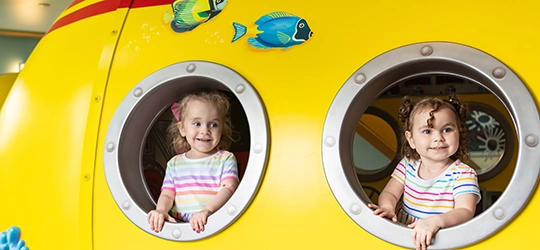
One minute, Rebel Timson, age 4, and Rio Timson, age 2 and a half, are sharing a granola bar and reading a book together in the waiting room at The Costas Center at SSM Health Cardinal Glennon Children’s Hospital. The next minute, Rio is pulling Rebel’s hair and Rebel is pushing Rio out of a wagon that, although quite large, is still too small to contain their energy. The sibling relationship may seem typical yet little else about these two is.
While still in utero, physicians diagnosed Rebel and Rio with autosomal recessive polycystic kidney disease (ARPKD), a genetic disorder characterized by the growth of cysts in the kidneys. Affecting one in 20,000 babies, ARPKD often leads to kidney failure. Approximately one third of affected children require a transplant within 10 years.
Once physicians diagnosed Rebel and Rio, providers referred the girls’ parents, Maggiee Underwood and Matt Timson, to Cardinal Glennon Children’s Hospital — ranked among the top pediatric nephrology hospitals in the country by U.S. News and World Report — and to the SSM Health Cardinal Glennon St. Louis Fetal Care Institute. Weekly, sometimes twice-weekly, visits became routine.
Rough starts
After her birth, medication helped manage Rebel’s ARPKD symptoms but at 18 months old, her cystic growth led to significant enlargement of one kidney. The enlarged kidney compressed her stomach, and it became difficult for Rebel to eat and take her medications. “Simply put, her body wasn’t growing fast enough to contain her kidney,” says Underwood.
Surgeons removed Rebel’s enlarged kidney to alleviate the pressure and placed a gastrostomy tube (G-tube) into her stomach to deliver nutrition, fluids and medications. The cysts on Rebel’s remaining kidney, however, continued to grow and her blood pressure skyrocketed. At barely 4 years old, a kidney transplant became her best option for survival.
Rio’s ARPKD was more serious from the beginning. Following her birth, clinicians determined that Rio’s kidneys were significantly impaired due to the presence of multiple large cysts. Rio developed end stage renal disease. She was not quite 2 years old when surgeons removed both of her kidneys and placed Rio on dialysis. Surgeons also fitted Rio with a G-tube, and a kidney transplant became her best option for survival as well.
“We knew there was no cure and both girls eventually would need transplants,” says Underwood. “We didn’t fully understand the transplant process or the gravity of the surgery, but once we learned we could be their donors, we had no hesitation.”
Katie Gruenkemeyer, RN, MSN, CPNP, a pediatric nurse practitioner with the transplant team at Cardinal Glennon Children’s Hospital, has been caring for the girls throughout their journey. “Maggiee and Matt were adamant about donating their kidneys to their daughters,” says Gruenkemeyer. “They had determination from the get-go.”
The match game
Chintalapati Varma, MD, surgical director of the liver and kidney transplant program at Cardinal Glennon Children’s Hospital and professor of surgery in the Division of Abdominal Transplant Surgery at Saint Louis University School of Medicine, says hospital surgeons perform seven to 10 pediatric kidney transplants each year.
Living donor transplants are preferred because they offer higher success rates and eliminate the need to join the transplant waiting list. While many parents hope to donate, medical or personal factors may present obstacles.
Underwood says she and Timson were “ecstatic” when they learned they were a match for their daughters. In October 2024, Underwood donated her kidney to save Rio’s life. In May 2025, Timson donated his kidney to save Rebel’s life. All surgeries went well.
“We pride ourselves on the care we provide for our patients and families,” says Dr. Varma, who performed the donor surgeries, was lead surgeon on Rebel’s transplant and assisted with Rio’s transplant. “Our patient and graft survival rates are superb and above the national average. Living donation is an amazing gift of life, one anyone can give.”
Playing both sides
Underwood says being a parent-to-child donor is not without its challenges. The girls continue to require maintenance of their G-tubes. They also have small, disc-shaped ports implanted in their chests to provide easy access for blood draws and medication administration. Rebel and Rio’s parents monitor their food intake and activity levels.
“Basically, you’re playing both sides of the game,” says Underwood, who quit her job to focus on the family’s health needs. “You’re taking care of the patient, yourself as the donor, the medications, the appointments, the insurance. It’s exhausting but rewarding.”
Underwood says the family could not manage without the support of their care team members at Cardinal Glennon Children’s Hospital — all of whom are in the same building and available at any time. “I needed to take Rebel to the emergency room one weekend for an issue with her G-tube and I reached out to Katie for guidance,” recalls Underwood. “She called me right back and said, ‘I’m at a T-ball game but let me walk you through this.’ It’s obvious they love their jobs and care for our kids as much as we do.”
Spiderman and unicorns
During today’s appointment at The Costas Center, Gruenkemeyer reports the girls are flourishing. Their lab results looked good, and Rebel got clearance to play soccer. “Both girls are on multiple medications, one of which is prednisone,” Gruenkemeyer says. “If you’ve ever been on prednisone, you know it adds a little spice to your life. Moods and emotions are a little more variable on steroids, especially with toddlers. Watching Maggiee parent both girls in clinic is inspiring and admirable.”
Underwood’s patience is being tested today as the girls repeatedly ask for snacks and compete for her attention while she tries to get her questions answered. Underwood says Rebel and Rio always have been playful children, but the transplants seem to have supercharged them. She describes Rebel as a caregiver who enjoys singing, dancing and unicorns. Rio, she says, is more of an instigator who likes to tease her sister, play Spiderman and sing Taylor Swift songs. During today’s visit, Rebel’s top-of-her-lungs rendition of “Who Let the Dogs Out” reverberates in the clinic room.
“It’s amazing to see their personalities blossom,” says Underwood. “They have so much more energy and stamina to move around and just be normal kids. It proves their condition truly was holding them back.”
This story was featured in the 2025 issue of Glennon Magazine.
link
About the Author




:max_bytes(150000):strip_icc()/VWH-GettyImages-2157903338-69370a8ef92e449b8958c22cab26dd28.jpg "What Happens to Your Gut Health When You Eat Wild Blueberries Regularly")