
The groundbreaking ceremony for the National Kidney Foundation of Hawaiʻi’s new building in Kapolei was a major affair.
Local dignitaries showed up, including State Rep. Ty Cullen, Honolulu Councilwoman Kym Pine, state Sen. Mike Gabbard, and retired U.S. Sen. Daniel Akaka — for whom the $20 million Oʻahu project would be named.
TV cameras rolled as they smiled and stuck ceremonial ‘ō‘ō sticks in the dirt on that day in 2016 to mark the kick-off of a planned 20,000-square-foot kidney health resource center, which was to include a teaching kitchen for patients with kidney disease.
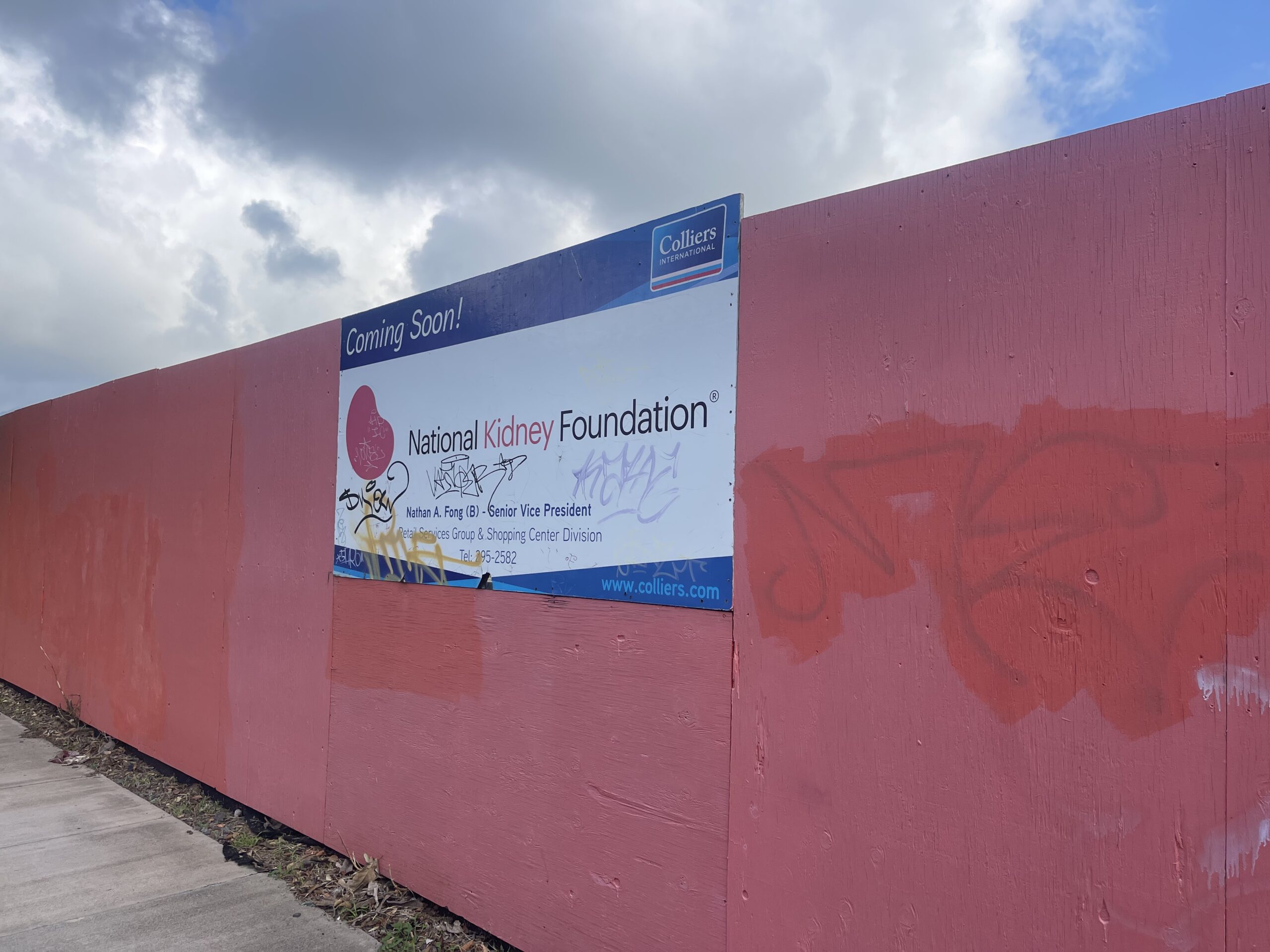
Nearly a decade later, the lot is still vacant.
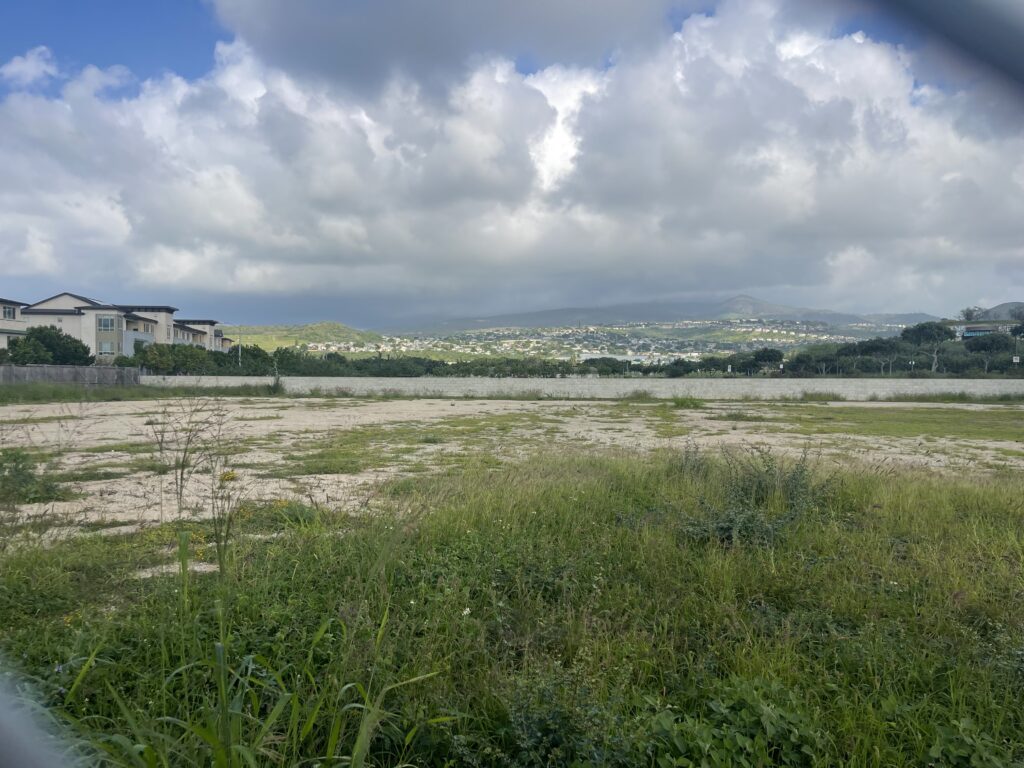
Covered in weeds and surrounded by fencing, the only clue to what the project was meant to be is a graffiti-covered sign with the National Kidney Foundation logo that says: “Coming Soon!”
In the last 10 years, the Kidney Foundation collected at least $3 million from the state to support the project, according to the departments of labor and health. In its pitch to the state, the foundation underscored the urgency for the center, saying it would serve the tens of thousands of Hawaiʻi residents who suffer from chronic kidney disease, many of whom are not referred to a nephrologist until their kidney function reaches 20%.
“At that point their kidneys will fail,” it wrote. “If we can reach them and adjust their lifestyle and nutrition as well as monitoring other related issues, we can stop or slow the progression of kidney disease.”
The Kidney Foundation’s IRS filings show it in turn paid out about $1.75 million to firms associated with Dennis Mitsunaga, a politically connected contractor who was tried and acquitted of public corruption in a high-profile 2024 trial.
The firm he founded, Mitsunaga & Associates, Inc., received approximately $750,000 for architecture services between 2022 and 2024, according to the foundation’s IRS disclosures. And Lincoln Builders — a company headed by Mitsunaga’s late son, Bert Mitsunaga — got an even $1 million for “Kapolei construction” between 2021 and 2022, the disclosures state.
There is little to show for it beyond a retaining wall.
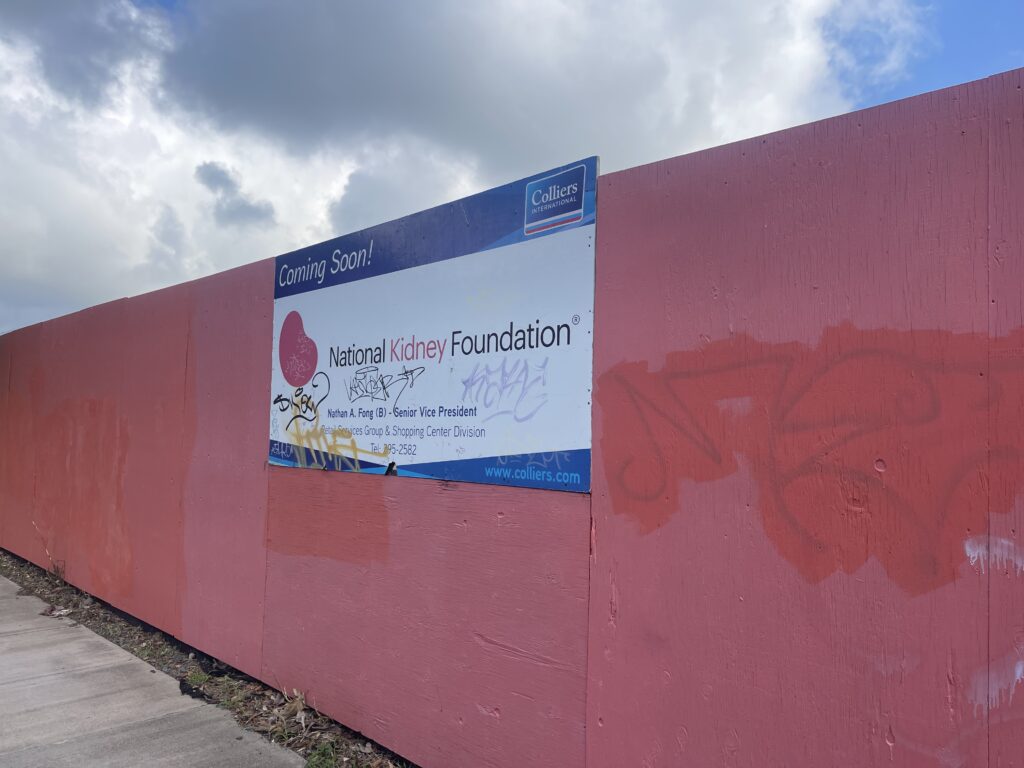
County permitting records show the wall was estimated to cost $250,000. What exactly it is retaining is unclear, as it seems to simply divide the foundation’s vacant lot from the property next to it, which is also a vacant lot.
The plans for the $20 million building itself weren’t submitted to the Department of Planning and Permitting until September 2023 and public records show they are still pending. A separate permit application for $1 million in “sitework” was submitted in November 2023. That permit remains under review.
The long-delayed project is attracting renewed attention amid a flurry of scrutiny of the National Kidney Foundation of Hawaiʻi and one of its former consultants, Tobi Solidum.
A longtime contractor for the foundation, Solidum has become embroiled in a political scandal involving campaign donations, and records show his company made millions off the foundation’s government-funded Covid testing work.
Solidum was working with the Kidney Foundation at the time of the Kapolei groundbreaking, but it’s unclear what involvement he had in it, if any.
Glen Hayashida ran the Kidney Foundation for 30 years before his retirement last year. Civil Beat has been unable to reach him for comment, nor could we reach Aileen Utterdyke, who an IRS filing lists as the board president as of 2024. Lois Mitsunaga, CEO of Mitsunaga & Associates, did not respond to an interview request.
Colin Moore, a local political scientist, said he is dumbfounded and wonders if the project’s state funders ever checked back in on it.
“It seems bizarre,” he said. “It’s a major foundation that had a public groundbreaking that received a significant amount of state funding for a project that was never built.”
In a statement, National Kidney Foundation of Hawaiʻi CEO Maile Kawamura, who has only been on the job four months, said the organization is committed to advancing kidney health and supporting patients and families “with integrity and trust.”
“We are aware of the recent reporting regarding the COVID-19 testing program conducted during the public health emergency and the Kapolei property development, both of which occurred under prior leadership,” she said. “The current leadership team and board are reviewing records from that period to ensure clarity and accuracy.”
Kidney Foundation’s Consultant Under Scrutiny
Solidum appears to be someone the FBI considered the subject of a bribery investigation as far back as 2021.
In October that year, Rep. Cullen was arrested for taking bribes and became a cooperating FBI asset, recording his interactions for the investigation. That January, a man gave Cullen $3,000, supposedly to help him with an “official request,” and later gave $35,000 to another “influential” lawmaker while Cullen secretly recorded, according to a Department of Justice document that inadvertently became public last year.
Lt. Gov. Sylvia Luke suggested this week that she could be the influential lawmaker in question, although she denies taking $35,000. She acknowledged, however, that she accepted $10,000 from Solidum and his stepdaughter in January 2022, then returned it, but failed to report it until recently, after Civil Beat asked about it.
That admission has put the spotlight on Solidum, raising the question of whether he was the man behind the $35,000, and consequently his nonprofit work.
A Civil Beat review of Solidum’s involvement in the Kidney Foundation’s work shows the nonprofit collected at least $100 million in government funds for Covid-related services during the pandemic — $35 million from Honolulu and at least $70 million from the Hawaiʻi Department of Health, according to public records.
Meanwhile, the Kidney Foundation gave $100 million to Capture Diagnostics, a company for which Solidum was both a subcontractor and investor. His own company, GeoPolicy Development Group, and a trust in his stepdaughter’s name, together took in at least $8 million.
Solidum’s friends and allies also benefited with jobs. For example, Gary Kurokawa, Mayor Kirk Caldwell’s chief of staff, signed off on a no-bid emergency contract for the Kidney Foundation only to get a job with the testing project.
Civil Beat has not been able to reach Solidum for comment. Kurokawa and Caldwell did not respond to messages.
A Shared Vision To Support Kidney Patients
The Hawaiʻi Legislature granted the Kidney Foundation millions over the years for the Kapolei project through its Grants-In-Aid process.
Some funds went unused and expired, but at least $3 million was both released and spent.
In Fiscal Year 2014, the Department of Labor granted the organization $1.5 million: $275,000 for planning, $25,000 for design and $1.2 million for land acquisition.
“The space will focus on chronic kidney disease prevention services, program and rehabilitation needs of patients, and innovative initiatives that involve community collaboration,” says a project description provided by the labor department.
A contract document says the contractor “shall construct the building at the aforementioned site” and submit documentation that “sufficient funds are available to complete the portion of the project using state funds.”
The labor department said it didn’t have additional records on file because a records retention policy calls for the destruction of such records after six years.
In Fiscal Year 2017, the foundation was granted $1 million from the Legislature’s Grants-In-Aid but only $158,000 ended up being released from the labor department. The other $852,000 expired because the foundation was “unable to obtain approval from City of Kapolei Design Advisory Board,” according to labor department spokesman Bill Kunstman.
Two years later, the Legislature granted the foundation $600,000. None of that was released, Kunstman said, because the foundation didn’t report any expenditures.
The Department of Health also backed the project, providing about $2 million in Fiscal Year 2015, although only $1.5 million ended up being spent.
“The project Includes acquisition, construction, planning and design of a 20,000 square foot Program Development Center and Senator Akaka Community Center,” DOH contract records state.

Sign up for our FREE morning newsletter and face each day more informed.
link
About the Author



:max_bytes(150000):strip_icc()/VWH-GettyImages-2157903338-69370a8ef92e449b8958c22cab26dd28.jpg "What Happens to Your Gut Health When You Eat Wild Blueberries Regularly")