

CareOregon has long footed the bill for its Oregon Health Plan members to see out-of-network behavioral health professionals. That’s changing, and soon.
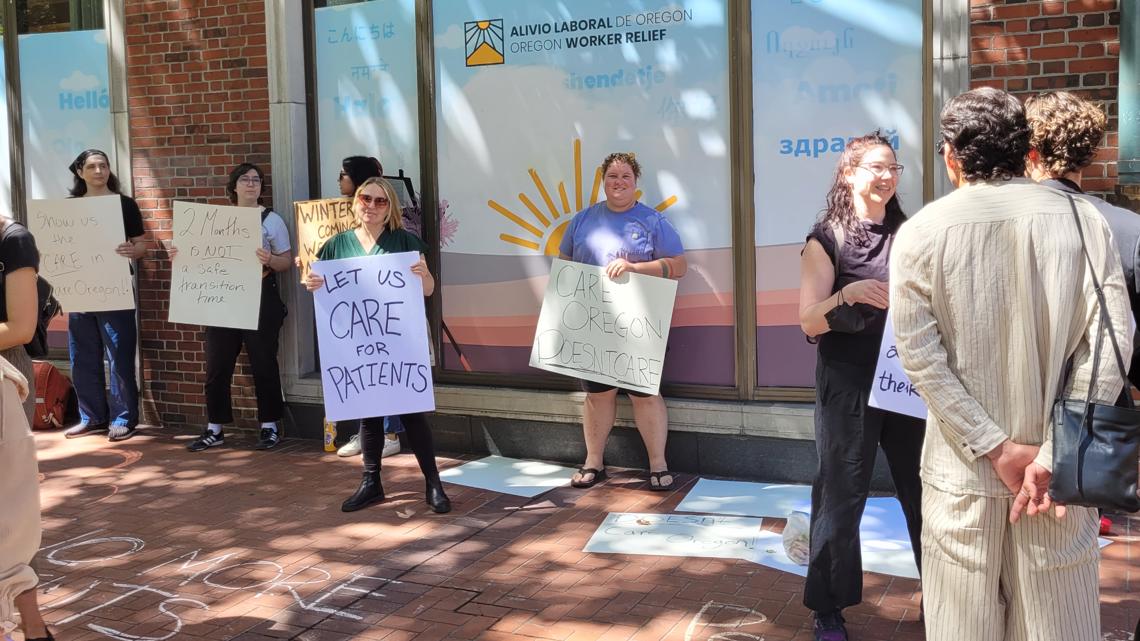
PORTLAND, Ore. — Beginning in less than two months, Oregon’s largest Medicaid insurer will drop behavioral health service providers currently treating thousands of patients throughout the state, leaving those patients scrambling to find treatment from a smaller and suddenly even more in-demand group of therapists and counselors.
The policy change has provoked an uproar among impacted clinicians and their clients, many of whom are engaged in care for significant mental health conditions.
In Oregon, Medicaid is known as the Oregon Health Plan, and it’s offered regionally through servicers known as coordinated care organizations, or CCOs. The nonprofit CareOregon operates two CCOs — Jackson Care Connect in southern Oregon and Columbia Pacific on the north coast — and is a primary partner in Health Share of Oregon, a CCO serving the Portland metro area. For clients with Medicare Advantage plans, the company operates CareOregon Advantage.
The insurer says it serves about 500,000 members across the state.
RELATED: Hillsboro therapists facing Medicaid cuts could be forced to drop dozens of clients
For years, CareOregon has allowed out-of-network behavioral health providers to take on clients with OHP and bill their insurance without being under contract. But on July 31, the insurer posted an update on its website saying that in two months, that would be coming to an end.
Effective Oct. 1, non-contracted behavioral health providers can no longer bill the company for their Medicaid patients. Then, effective Jan. 1, non-contracted providers will no longer be able to bill for Medicare Advantage patients.
CareOregon told KGW that these changes will impact about 15,000 members — 3% of the insurer’s total members, but about 15% of members who use behavioral health services. The insurer declined to answer any further questions about those affected.
RELATED: Sober housing beds sit empty in Portland as operators grapple with new funding requirements
And this won’t impact patients alone. CareOregon will jettison about 24% of its behavioral health provider network, KGW news partner the Portland Business Journal reported — namely mental health therapists and providers of substance use disorder services who aren’t currently under contract.
What this means, in effect, is that the number of behavioral health professionals who can see clients insured through OHP will shrink suddenly within the next few months. Those 15,000 patients will need to find someone in-network to see them instead, if they can.
“This policy change will allow CareOregon to continue meeting the needs of our members under new financial constraints, including sweeping federal Medicaid cuts,” CareOregon said in a statement. “We understand it is challenging to change providers, and we will work to minimize any disruption by reaching out directly to impacted members to help them transition smoothly to contracted providers.”

The bearers of bad news
Therapist Linda Nguyen didn’t find out about CareOregon’s policy change from the insurance company. She found out last Friday, while scrolling on Facebook.
“I came across a post in one of the Facebook therapy groups, and it said, like, ‘Did anyone see this?’ And it was a link to the update on CareOregon’s website,” she said.
A licensed clinical social worker, Nguyen has been in private practice in Portland since 2020. She has 17 clients, and 10 of them are insured through CareOregon. She works with adults, primarily survivors of domestic violence and sexual assault.
But Nguyen isn’t a contracted provider, so she’ll need to let go of all 10 of those clients by October. When she first saw the news, she said, she immediately had a panic attack. Then, she had to get to work.
“So first thing, 9 o’clock Monday morning, I’m already sending a mass email to clients and checking in with them that they’d received it, and then going through it together in session,” Nguyen said. “None of my clients knew what was happening. I was their first point of contact.”
That’s one small part of the frustration for Nguyen — that CareOregon was upending behavioral health care for all of these people, but hadn’t seen fit to contact them directly.
“I don’t know if other clients have been informed or not, but specifically, my clients have not,” she said. “And I think there’s a little bit of that disappointment and frustration that I’m the person delivering the bad news.”
Chelsea Harrington is the owner and clinical director of Bridges Therapy, a group practice in Southeast Portland with 10 different clinicians, serving primarily clients on OHP. Between them, Harrington estimates they’ll be losing over 100 CareOregon clients.
“With this rule change giving us only 60 days to refer these clients out and find other sources of clients,” Harrington said, “most likely we won’t be able to survive this change.”
Nguyen, too, is losing more than half of her livelihood in one fell swoop. And her clients, some of whom have worked with her for over five years, are losing a provider they trust.
“The clients that I’ve spoke to in session, they’re very sweet and respectful. They want to really make sure I’m OK, which is amazing of them, which is fantastic,” Nguyen said. “But they’re also worried, not even just losing care with me, but they’re worried about future impacts. Like a lot of them so far this week are like, ‘Am I gonna lose my insurance overall, too?’ And I can’t say with confidence, like, ‘No, you’re, you’re gonna be OK.’ You know?”
According to Nguyen, she tried to become contracted with CareOregon back in 2023. She said they never responded to her inquiry.
A mailing Nguyen received from CareOregon this week had an email address to contact with questions about getting contracted. But she doesn’t think they’re in any hurry to contract more providers, and neither does Harrington.
“There’s not even a number we can call, it’s just referred to this email, basically,” Nguyen said. “And as you can imagine, so many people are emailing, so it’s just getting lost in the thread.”
“They haven’t been open to contracting for years,” Harrington agreed. “I filled out all the forms, I’ve called all the numbers and I’ve received no response. And again, it just makes me concerned that maybe this half-gesture of inviting practices to contract is really just performative. It’s not really a sincere attempt.”


Sixty days to start over
Nguyen doesn’t have intimate knowledge of CareOregon’s contracted providers. But the therapists she knows who are under contract, she said, don’t have any openings to take on these clients who are being cut loose.
“And as we see hundreds of private practices now being impacted, thousands of clients losing care — when it’s already difficult to be in a group practice that already has a waiting list or is already at capacity — I don’t believe that there’s gonna be ongoing care for clients moving forward,” she said.
“It’s expected that it will be exponentially harder for (these clients) to find providers, now that CareOregon is significantly limiting the pool of providers that can bill their services,” said Harrington. “With only 60 days notice, it’s an incredibly irresponsible decision that is completely negligent of not only of providers and our businesses, but of clients and their well-being.”
Even if CareOregon is serious about bringing on more contracted providers, Harrington said, that process typically takes months. It’s not likely to happen for anyone in time to prevent this disruption of care for the clients.
“I understand that as an organization you have to adapt to what are going to be changes in Medicaid funding on the federal level,” said Harrington. “But this is not the way to do that. It’s not. You should not make the Medicaid recipients be the ones that have to experience the consequences of that.”
Viyada Ruscigno is a client of Bridges Therapy on OHP who agreed to speak about her experience with KGW. She’s been diagnosed with complex post-traumatic stress disorder (CPTSD), and sees a provider with the specialty training to do EMDR therapy, an evidence-based treatment for trauma.
Ruscigno said she’s been seeing her therapist for four years now, and it took her years before that to find someone she felt listened and could understand her.
“It has been a healing process for me, understanding my traumas and how it’s affected me through my career and in my day-to-day living,” she said.
Having to find a new provider means, in some ways, having to start over — to go through the traumas all over again. It’s gut-wrenching, Ruscigno said, and not something she even wants to think about.
“You can go through so many that don’t fit and you try to make it work,” she said. “But when you finally do find that perfect pair of jeans, then that perfect provider, that mental health provider, you realize how comfortable and how beautiful, you know?”
Ruscigno felt blindsided by the news this week, and she feels that it represents a failure by policymakers.
“Quite literally shocked at how quickly and unorganized this has become,” she said, “and I feel that it will be the fault of politicians, and it will be felt in our community.”


Why now?
CareOregon’s latest policy change follows a number of efforts to cut costs this year. In July, the insurer laid off 80 employees and eliminated nearly as many vacant positions, The Oregonian reported. And previous policy changes have attempted to chip away at the costs of paying care providers.
“They’re trying to strategize how they can limit the amount of reimbursements they’re having to give out for services,” said Harrington.
In December, the insurer announced that it would no longer pay non-contracted “associate providers” for behavioral health services. The term applies to providers who are board registered but are still working on getting licensed.
That change wasn’t set to go into effect until Aug. 1 of this year, so those associate providers had over seven months from the time of the announcement to the deadline. And in the meantime, Nguyen said, some of those associates offloaded their clients to providers who are now being impacted by this most recent change.
“A lot of associates were like, ‘I can’t work with this client anymore because of my situation; I want to transfer clients out,’ and a lot of associates transferred clients to non-contracted providers in private practice,” she said. “And so the clients who already got transferred, now they have to say goodbye to another therapist only two months later.”
Then in June, CareOregon told behavioral health providers that it would be enacting a billing policy change backdated to Jan. 1, 2024, forcing the impacted providers to re-process hundreds and claims going back a year and a half — and do it within 30 days, according to one provider. That timeline was later extended to 90 days.
After an uproar about the policy change, CareOregon ultimately reversed course and announced July 14 that it would not be retroactive.
CareOregon CEO Eric Hunter has been vocal about the coming impacts from President Donald Trump’s “Big Beautiful Bill” on Medicaid, containing cuts that will ultimately result in fewer people being covered.
RELATED: Oregon leaders sound the alarm about Planned Parenthood cuts buried in ‘Big Beautiful Bill’
But, Hunter told KGW’s Blair Best in early July, the real consequences of those Medicaid cuts are still to come.
“People should be concerned, not for the immediate impact of this bill, now law,” Hunter said. “I think the things that are built into it, though, are so massive that they will fundamentally change the funding structure of the entire health care system.
“It’s not just Medicaid … the health care system as we speak is very fragile, it is already struggling with workforce shortages, with ER utilization, SUD and behavioral health needs, and thinking that this is coming down the pike is really stressing the system.”
Hunter told the PBJ that CareOregon had burned through hundreds of millions of dollars within the last few years, depleting its reserves, and all well before these coming Medicaid cuts. That’s essentially why the insurer says it is cutting off non-contracted behavioral health providers now — it can no longer afford them.
According to a statement from CareOregon, the pandemic created a rising demand for behavioral health services as the state faced a shortage of providers. At the time, the insurer sought to meet the moment by opening its network to both contracted and non-contracted providers.
“I’ve been, honestly, very grateful for CareOregon up until now,” said Nguyen. “Previously I was working at a clinic and then I opened up my private practice, that clinic allowed me to work with my OHP clients in private practice. So, you know, during COVID and this transition, I was really thankful for the out-of-network billing, because I got to continue with my care, with my clients.”
Harrington said much the same about the providers at her group practice.
“Yes, they opened up their network because of the, you know, exponential increase in need for behavioral health services, but that hasn’t changed. The need is still there,” Harrington said. “So much of what we talk about in Oregon about our future as a state is increasing behavioral health access, and this is in direct contradiction to what that mission is.”
CareOregon acknowledged that health care needs in the state are still growing, but so are costs. And it claims that services from non-contracted providers cost “as much as 40%-95% more than from contracted providers.”
In its announcement, CareOregon said it “must do more with less.”
“With a smaller network of providers, we can streamline administrative management and focus on delivering high quality care to our members,” the insurer said. “This change is also in line with industry standards.
“These changes are not a reflection of the value or importance of non-contracted providers. We value all our provider relationships and recognize the critical role they play in our health care system.”
KGW reached out to Gov. Tina Kotek’s office for comment on the CareOregon policy change and did not receive a response. A spokesperson for the Oregon Health Authority said that they would provide a statement, but did not send one by time of publishing.
link
About the Author






:max_bytes(150000):strip_icc()/VWH-GettyImages-2157903338-69370a8ef92e449b8958c22cab26dd28.jpg "What Happens to Your Gut Health When You Eat Wild Blueberries Regularly")