
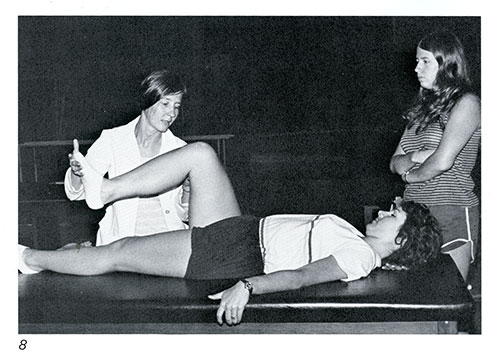
Gerber says that the program’s rigorous education and ability to adapt to the latest treatment techniques continue to prove itself year after year, especially among professionals who take Pacific students for clinic rotations, a critical part of the hands-on learning experience.
“We had a clinic in Utah that said that they were ready to just not take students anymore,” Gerber said. “Then they had one of our students, and they got reinvigorated. It gave them more faith in physical therapy education when they had our students. So I think it’s the preparation and the high expectations that we demand from our students.”
The physical therapy program is Pacific’s second-oldest graduate program, predated only by the optometry program, which became part of the university in 1945. The addition of physical therapy proved to be the genesis of Pacific’s growth from a liberal-arts undergraduate institution to a comprehensive university with robust undergraduate and graduate offerings, with a specific focus on healthcare. Since the advent of the physical therapy program, Pacific has added graduate degrees in eight other healthcare-related fields.
Education & Adaptation
Just as Pacific has changed over the last 50 years, the physical therapy profession has also changed.
When it started in 1975, physical therapy classes were taught in what is now the Stoller Center on the Forest Grove Campus. Today, the program enjoys a state-of-the-art facility on Pacific’s Hillsboro Campus, where it shares a building with several of the university’s other healthcare programs.
Through the 1970s and 1980s, physical therapists relied on ultrasound, TENS and other electrical stimulus modalities as primary treatment techniques. Those are still used today, but professionals rely more on manual therapy techniques and exercise as primary interventions.
“There is really a lot more manual therapy used and moving people to exercise,” Gifford said. “And then there are growing specialties like pelvic health therapists and pediatric therapists. The types of patients we’re getting after surgery are able to do things a lot faster than when I first came out.”
The evolution in treatment, Gerber said, has helped make physical therapists more valuable in the larger scope of care for the whole person.
“Physical therapy is focusing on what methods work most effectively and where we should be with the training; which is often a higher emphasis on hands-on interventions,” he said. “We’re working within the whole medical system a bit more instead of being so siloed.”
Being at the cusp of that evolution, Gerber added, will help keep Pacific physical therapy graduates at the top of the list for the next 50 years. “We are focusing on the things we do well, but also focusing on evidence-based practice and asking ‘What is the best way to educate?’” he said. “It’s important to stay relevant and current.”
It’s not just about being on top of the latest therapy techniques. For Condiss, who also serves as an adjunct professor, it is also about the continuing focus on being a patient-focused clinician, walking side-by-side with pateints on their journey.
“It’s not about us as clinicians. It’s not about what I want for the patients. It’s about how can I meet them where they’re at and help get where they want to be to the best of my ability,” Condiss said. “The focus on community, thinking about the patients that are right in front of you, that wider array of who needs help, how we can foster that and be a larger part of the solution has been really uplifting.”
That atmosphere of uplifting patients is nurtured by an atmosphere where faculty and students within the Pacific physical therapy program uplift each other.
“Everybody belongs,” Gerber said. “We really focus on belonging and making sure that everyone feels like they belong here. I think you have great experiences when you learn how to exist with others who may not be like you. It just flows through our culture.”
Condiss sees that attitude in action every day, whether in the Pacific classroom or in her fellow Pacific alumni clinicians. It affirms what attracted her to physical therapy in the first place.
“I love the open environment that we have here,” she said. “The faculty wants everyone to succeed. You get a feeling that people feel like they belong.
“I love the emphasis for helping foster and grow excellent clinicians, focusing on patients and trying our best to be the best clinicians we can for our patients. The community that we build here is wonderful.”
link
About the Author



:max_bytes(150000):strip_icc()/VWH-GettyImages-2157903338-69370a8ef92e449b8958c22cab26dd28.jpg "What Happens to Your Gut Health When You Eat Wild Blueberries Regularly")